
Choose a Pool Shape by the Activities Inside It
Help your family compare pool shapes by describing actual swimming activities, interior features and the relationship between the pool and yard.
Choose a Pool Shape by the Activities Inside It
Choose a pool shape by asking what the household wants to do in the water, then have a professional translate those activities into a suitable design. A curved or straight outline is only the beginning of the decision. Steps, benches and the arrangement of usable water space can matter as much as the silhouette that first catches your eye.
Write the activities before selecting the outline
Describe a familiar group using the pool on an ordinary day. One person may want uninterrupted swimming, while another prefers quiet time sitting in the water. Children’s interests may change as they grow. Record those uses without attempting to prescribe depths or technical dimensions. The designer needs to understand the intended activities before explaining the appropriate options.
Separate regular use from occasional ambitions. A household can spend a large share of its design discussion accommodating a hypothetical party while overlooking the two people who will use the pool most often. Ask which activities would make the project worthwhile even in a quiet week. Those answers provide a clearer basis for comparing shapes.
Be explicit about activities that require particular professional consideration. Never infer that a pool is suitable for diving, jumping or another activity from its appearance in a photograph. Raise the intended use with the qualified designer and builder, who should establish what is appropriate. General shape labels do not communicate the conditions needed for safe use.
Invite each household member to describe their preferred experience before presenting a favourite drawing. People often adapt their wishes to the first attractive proposal they see. A short conversation without images can uncover priorities that would otherwise remain unstated, such as wanting a quieter corner or avoiding a layout dominated by one large interior feature.
Examine the space left after steps and interior features
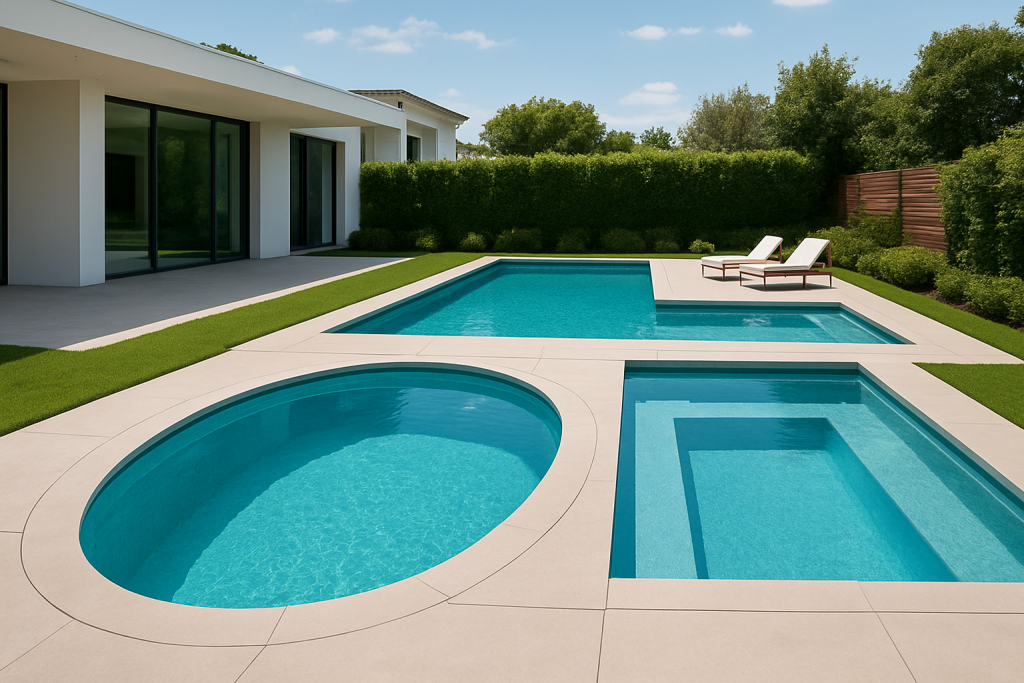
Ask to see the proposed interior features clearly on the plan. An outline that appears generous can contain substantial steps, benches or a sunledge. Those features may be exactly what the family wants, but their relationship to other activities should be visible. Compare the usable arrangement rather than assuming equal overall dimensions produce equivalent experiences.
A feature should have an identified user or purpose. A bench may suit someone who enjoys remaining in one place, while another household might place greater value on a less interrupted area for its preferred swimming. Discuss these tradeoffs with the designer. An attractive feature does not become necessary simply because it appears in many inspiration photographs.
Ask how people enter and move through the proposed pool during the activities described in the brief. The professional should explain the design without relying on the owner to interpret technical drawings unaided. If the explanation remains abstract, request another view or a clearer illustration of the relevant feature, rather than approving something you cannot visualize.
Keep the conversation open to refinement. A family that initially asks for a particular shape may discover that a modified arrangement serves its priorities better. The useful part of the original preference is the reason behind it: a certain look, a swimming activity or a relationship to the garden. That reason can guide alternatives even when the outline changes.
Let the surrounding yard influence the final silhouette
The pool also has an outside edge, and that edge shapes the space around it. Ask how each candidate layout relates to the house, seating, planting and required circulation. A pool that satisfies the activity brief in isolation may still need adjustment to make the complete backyard comfortable. The remaining outdoor space deserves a deliberate plan.
To understand an integrated project approach, see the pool design and build overview from Jameson Pool & Spa. Its offering connects custom pool construction with the surrounding landscape. Discussing those elements together gives the household a way to compare shape preferences in the context of the whole property.
Review the view from rooms used regularly. A curve can lead the eye differently from a straight edge, but the preferred effect depends on the setting and the viewer. There is no need to declare one geometry universally more modern, natural or luxurious. Ask which proposal looks right with the existing house and the landscape the family wants to keep.
The site’s technical and approval requirements must be established by the project team. Do not select a shape on the assumption that every part of a visually open lawn is available for construction. The designer should explain the actual constraints and how the proposal responds to them. That information belongs alongside the family’s preferences in the decision.
Compare two drawings using the same afternoon
Keep the comparison manageable by testing two plausible proposals against the same use scenario. Describe who arrives, what each person does and where the non-swimming activities happen. Using a consistent scenario prevents the family from imagining a relaxed weekday for one drawing and an unusually crowded celebration for the other. Consider activities happening together, too: a design may explain each preference separately without showing how the regular users share the space during the same visit.
Write down one meaningful strength and one compromise for each proposal. These might concern an interior feature, the relationship to the dining area or the overall view. Ask the designer to clarify any point the household is uncertain about. The exercise is not a technical score; it is a way to make personal priorities visible before committing.
Choose the drawing that best explains the afternoon your household expects to enjoy. The final answer may still be a rectangle, a curve or another custom shape, but the label will no longer carry the decision on its own. The family will know what the shape is there to support.
What You Need to Know
- Selecting a pool shape should begin with identifying household activities to be performed in the water.
- Households should document their intended uses of the pool before determining its dimensions or outline.
- The relationship between interior features and usable space in the pool must be clearly illustrated in the design plan.
- It is important to discuss and clarify the intended activities with the designer to ensure safety and suitability for those activities.
- The surrounding yard and how it integrates with the pool design should be considered to create a comfortable outdoor space.
- Comparing two pool designs against the same activity scenario can help families make a better-informed decision.