
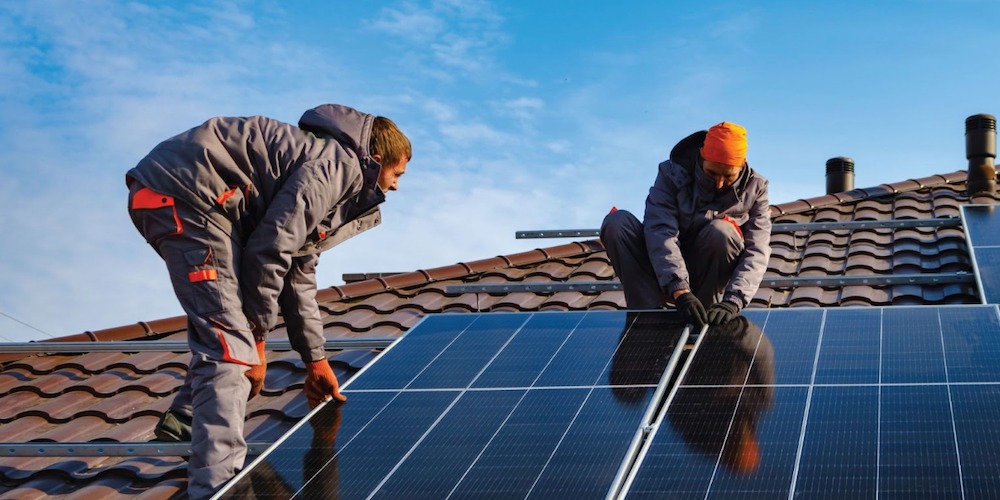
Before You Fit Solar Panels, Ask What Is Underneath Them
The rush towards rooftop solar has changed the way many homeowners think about their roofs. A surface that once existed purely to keep the weather out can now generate electricity, reduce reliance on the grid and become an important part of a property’s energy strategy.
There is, however, an awkward question that can get lost in the excitement.
How long does the roof underneath the solar panels have left?
It sounds obvious, but it is surprisingly easy to overlook. Solar panels are a long-term installation. Putting them onto a roof that may require significant repairs or replacement within the next few years can create unnecessary expense, because accessing the roof later may involve removing and reinstalling the panels.
The sensible order is straightforward: understand the condition of the roof first, then decide what should be installed on top of it.
Solar has changed the lifespan calculation
A homeowner considering solar will naturally spend time looking at panel efficiency, battery storage, installation costs and potential electricity savings.
The remaining lifespan of the roof may receive far less attention.
That matters because the two systems are about to become closely connected.
If a roof is in excellent condition and reasonably early in its expected service life, there may be little cause for concern. If it is already showing widespread deterioration, the calculation changes.
Imagine fitting a solar array this year and discovering five years later that the tiles beneath it need replacing. The roofing work itself may be perfectly manageable, but the panels are now in the way.
They may need to be disconnected, carefully removed, stored and then reinstalled once the roofing work is complete.
None of that improves the roof or generates additional electricity. It is simply an extra cost created by doing two sensible improvements in the wrong order.
An old roof does not automatically need replacing
This should not become an excuse for unnecessary reroofing.
Roof age alone is a poor diagnostic tool.
A well-built roof that has been properly maintained can remain serviceable for many years, while a considerably younger roof can develop problems because of poor workmanship, unsuitable materials or neglected maintenance.
The question before installing solar is not simply, “How old is the roof?”
It is, “What condition is it actually in?”
A proper assessment should consider the covering itself, along with ridge details, valleys, flashings, underlay where accessible, battens, structural condition and any evidence of previous water ingress.
Sometimes the conclusion will be that the roof is perfectly capable of remaining in place.
Sometimes a few local repairs are sensible before the solar installers arrive.
Occasionally, replacing an ageing roof first will make far more financial sense.
The most important problems are not always obvious from the ground
A roof can look reasonably tidy while still having areas that deserve attention.
Lead flashing around a chimney may be reaching the end of its useful life. A valley could be deteriorating. Tiles beneath an area destined for panels might already be cracked or poorly fixed.
Once solar panels cover part of the roof, inspecting and accessing those areas becomes more complicated.
That is why pre-installation checks should not focus solely on whether the roof is currently leaking.
A roof does not need to be leaking to need maintenance.
In fact, the ideal time to carry out many repairs is before water has found its way into the building.
For homeowners considering improvements, an assessment by an experienced residential roofing specialist can help establish whether remedial work is sensible before the solar installation begins.
Solar panels do not cause every problem that appears afterwards
There is also a tendency to blame solar installations whenever a roof develops a leak after panels have been fitted.
Sometimes the installation is responsible.
Sometimes it is coincidence.
If a 30-year-old roof develops a problem two years after receiving solar panels, the panels themselves are not automatically the culprit. An existing weakness may simply have progressed naturally.
This is another reason documenting the roof’s condition beforehand is useful.
It establishes a baseline.
If defects are identified and repaired before installation, there is much less ambiguity if a problem develops later.
It also gives the solar installer a sound surface to work with rather than asking them to attach equipment to roofing materials of uncertain condition.
Fixings deserve serious attention
Solar panels have to stay attached to a roof through years of British weather.
That means wind, rain, temperature changes and occasional severe storms.
On pitched roofs, mounting systems typically need to transfer loads safely into the roof structure rather than relying on the tiles themselves. Tiles primarily provide weather protection and should not be expected to act as structural fixings.
The details around attachment points therefore matter enormously.
Poorly considered penetrations can create routes for water. Incorrectly positioned components can interfere with tiles. Excessive pressure can damage brittle coverings.
Good installation requires the solar and roofing elements to work together.
The panel may be the technology everyone notices, but the waterproofing beneath it remains fundamental.
Surrey presents its own set of challenges
Solar makes obvious sense across much of Surrey, particularly on properties with suitable roof orientation and limited shading.
Yet the county’s housing stock is enormously varied.
There are modern estates, Victorian and Edwardian homes, large detached properties, converted buildings, period cottages and homes within conservation areas. Many are surrounded by mature trees.
That means there is no single roofing answer that applies everywhere.
A relatively modern tiled roof in an open suburban location presents a different proposition from an older property surrounded by mature woodland near the Surrey Hills.
Shade, falling debris, roof complexity, access and the condition of existing materials can all influence the installation.
For some properties, the challenge is not whether solar panels can physically be installed. It is whether the roof beneath them is the right candidate for a long-term installation without further work first.
Flat roofs need a different conversation
Solar is not limited to pitched domestic roofs.
Flat roofs on homes and commercial buildings can offer excellent opportunities for photovoltaic installations, particularly where there is substantial usable space.
The design considerations are different.
Drainage must remain effective. Maintenance routes need to stay accessible. Additional loads have to be understood. Waterproofing should not be compromised by poorly planned mounting systems.
The position of panels can also affect how easily outlets, seams and other important areas are inspected later.
Modern membrane systems such as Alwitra Evalon roofing can form part of sophisticated flat roof specifications, but the waterproofing and solar design need to be considered as parts of the same roof rather than two unrelated projects.
That becomes particularly important on larger installations.
Commercial buildings have more at stake
For businesses, the attraction of unused roof space is obvious.
Warehouses, offices, schools, retail units and industrial buildings can provide large areas suitable for electricity generation without consuming valuable land.
But the same basic rule applies on a much larger scale.
Installing a substantial solar array on a commercial roof that subsequently needs major refurbishment can create an expensive logistical problem.
There is also the question of access.
Commercial roofs contain outlets, plant, vents, rooflights and other equipment that may require regular inspection. Covering every available square metre with panels without considering future maintenance can make routine roofing work unnecessarily difficult.
A planned approach to commercial roofing should therefore consider what may happen on the roof throughout the lifespan of the building, not simply what can be fitted there today.
Think about the next contractor who needs access
This is an aspect of solar design that homeowners rarely hear discussed.
Someone will probably need to access the roof again.
It could be a roofer checking a flashing. A chimney specialist. A solar engineer replacing an inverter component. Someone clearing a valley or investigating storm damage.
Leaving sensible access can make those jobs safer and simpler.
A tightly packed installation may maximise theoretical generating area, but there can be value in considering maintenance at the design stage.
Buildings need servicing. Roofs need inspecting. Equipment eventually needs repairing.
A good installation should acknowledge that reality.
Do the disruptive work once
There is a broader principle here that applies to many property improvements.
If several jobs are likely to affect the same part of a building, it is usually cheaper and less disruptive to coordinate them.
A homeowner already considering reroofing, insulation improvements and solar should think about them together.
Scaffolding may be required for more than one job. Roof coverings may need to be disturbed. Ventilation might need reviewing. Flashings or gutters may benefit from attention at the same time.
Doing the work in a sensible sequence can prevent duplication.
The same thinking applies even if the roof does not need replacing. Completing minor repairs before panels arrive is considerably easier than discovering them afterwards.
The panels are only as secure as the roof beneath them
Solar technology is becoming an increasingly normal feature of British homes, and that is likely to continue.
The mistake is treating the roof as little more than a convenient platform.
It is still the primary weatherproofing system protecting everything beneath it.
Before calculating panel numbers and projected electricity generation, homeowners should understand whether the existing roof is capable of supporting the installation for the long term.
Sometimes that assessment will lead to substantial work.
More often, it may simply identify a few repairs worth completing while access is straightforward.
And in plenty of cases, it will confirm that nothing needs doing at all.
That is still valuable information.
A solar installation should add something useful to a property, not create an obstacle to maintaining it. Spending a little time looking beneath the proposed panels before they are installed is one of the simplest ways to make sure both the roof and the solar system can do their jobs properly for years to come.